
Today, during a Senate Armed Services Committee hearing on the Trump administration’s deployment of the National Guard across U.S. cities, Arizona Senator and Navy combat veteran Mark Kelly raised concerns about President Trump’s recent suggestion that American cities should be used as “training grounds” for the National Guard, and the risk that poses to civil-military norms and Americans’ safety.
Kelly underscored the difference between real public safety and turning American neighborhoods into military training grounds: “Americans deserve to feel safe in their communities. As the son of two cops, I understand the sacrifice and the hard work it takes to do that job. That’s why I know we’ve got to do more to support law enforcement, especially local law enforcement, those professionals who do that difficult job every single day. I also recognize that not every challenge faced in our cities should default to a military response. On September 30th, President Trump addressed military leadership, both senior officers, admirals and generals, and senior enlisted, at Quantico, about the deployments of National Guard to U.S. cities. And at that address, he said, and I quote, ‘I told Pete, we should use some of these dangerous cities as training grounds for our military National Guard,’ unquote.”
Kelly also pressed Guillot on the lack of precedent and danger of treating American communities as “training grounds”: “So, General Guillot, is there an established DoD policy that authorizes using civilian communities as training grounds and American citizens as training tools? […] Is there any precedent in DoD history for conducting combat-oriented training in American communities? […] Would it ever be okay to regard U.S. citizens as adversaries or enemies? […] I don’t mean it as a hypothetical, and even if there was illegal activity, that could be viewed that person is a criminal. I’m asking specifically, is it okay to regard U.S. citizens as enemies? […] My concern is that labeling a city as a training ground inherently puts civilians in a position of being an adversary or an enemy.”
In response, General Guillot made clear there is no Department of Defense policy nor precedent to use American cities as “training grounds” or to treat U.S. citizens as adversaries.
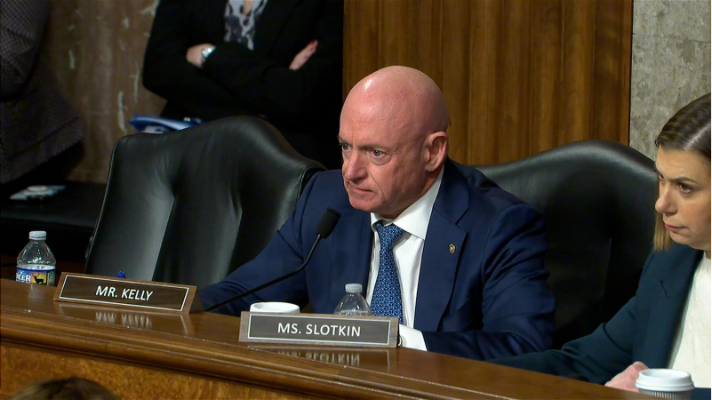
Sen. Kelly questions General Gregory M. Guillot, USAF, during a SASC hearing.
Click here to download a video of Kelly’s remarks. See the transcript below:
Kelly: Thank you, Mr. Chairman, I want to also express my condolences to Sarah Beckstrom’s family and also to Andrew Wolfe. I understand personally how hard it is to recover from those kinds of injuries. And, to my good friend, Senator Budd across the aisle, there’s nobody on this committee that is pro-cartel and pro-drug boat, or in this Congress.
General Guillot, Americans deserve to feel safe in their communities. As the son of two cops, I understand the sacrifice and the hard work it takes to do that job. That’s why I know we’ve got to do more to support law enforcement, especially local law enforcement, those professionals who do that difficult job every single day. I also recognize that not every challenge faced in our cities should default to a military response. On September 30th, President Trump addressed military leadership, both senior officers, admirals and generals, and senior enlisted, at Quantico, about the deployments of National Guard to U.S. cities. And at that address, he said, and I quote, ‘I told Pete we should use some of these dangerous cities as training grounds for our military, National Guard,’ unquote. So, General Guillot, is there an established DoD policy that authorizes using civilian communities as training grounds and American citizens as training tools?
Guillot: No, Senator, there is not.
Kelly: Is there any precedent in DoD history for conducting combat-oriented training in American communities?
Guillot: No, Senator.
Kelly: And have you been consulted at all about using any specific cities for training?
Guillot: Senator, I have not been consulted nor directed to use any American cities for training.
Kelly: And has any federal official asked you to plan training operations in U.S. cities?
Guillot: No sir, not training.
Kelly: And has NORTHCOM ever designated an American city as a training ground?
Guillot: No, sir.
Kelly: Thank you for that. If U.S. cities are training grounds, based on what the President had said and indicated he wanted the Secretary of Defense to consider doing, then how are the servicemembers in this scenario expected to perceive the civilian population in that environment?
Guillot: Senator, I can tell you that, for the areas that are under Title 10 control, we provide very clear training and reinforce that with daily meetings on what our purpose is there, and that is to protect federal buildings. It is not for any other function.
Kelly: But if you carried out the President’s objective of using a city for training, does this imply that civilians could be used as potential adversaries?
Guillot: Senator, I’m very confident that that is not a factor within my chain of command because of the very clear guidance and direction that we give on what the mission is and what our proper response to any activities there, which includes de-escalation, as the first step in standing rules for the use of force.
Kelly: So, what do you think the President meant by that statement?
Guillot: Sir, I haven’t thought into what he might have meant. I listened to it at the time and since then have only gone on what has been directly tasked to us and what my authorities and responsibilities are.
Kelly: Would it ever be okay to regard U.S. citizens as adversaries or enemies?
Guillot: Well sir, that’s a hypothetical. Our initial response is no. Now, of course, there could be illegal activity that’s underway, and we may have the authority vested in us to respond in accordance with the authorities that we have. But again, these are double, triple hypotheticals.
Kelly: I don’t mean it as a hypothetical, and even if there was illegal activity, that could be viewed that person is a criminal. I’m asking specifically, is it okay to regard U.S. citizens as enemies?
Guillot: No, sir.
Kelly: Well, thank you.
Guillot: We’d defend the United States and U.S. citizens. We do not view them as enemies.
Kelly: I agree with you. My concern is that labeling a city as a training ground inherently puts civilians in a position of being an adversary or an enemy, so I appreciate your response. Thank you, General.
